

Corporate Software Inspector: What It Is, How It Works, and Why Every Business Needs One in 2026
Pose just one query to an IT manager: “Can you name all applications that are being used on all devices in your organization at this point in time?” Chances are, most of them would hesitate for a second. Some would say that they do not know.
This difference between what IT believes is installed and what is really installed is where real harm occurs. Data breaches, license violations, ransomware vulnerabilities, audit failures – they almost always originate from software that no one was aware of.
That is precisely what a Corporate Software Inspector is designed to address. It’s not a role, nor is it a department. It’s a class of software governance technology that is meant to provide the organization with an up-to-date, accurate snapshot of all of the software running on its network, legitimate or not.
In this article, I’m going to go into detail about what a Corporate Software Inspector really is, how the whole process takes place, what features are important, and what differentiates this software from other ITAM solutions. The description will be based on practical experience rather than marketing descriptions.
What Is a Corporate Software Inspector?
The Corporate Software Inspector inspects the entire technological ecosystem of the company’s systems, be it desktops, laptops, servers, and even virtual machines.
However, its job does not end there. The inspector does not only count the number of installed software programs. No, it analyses the programs too. This includes identifying any unauthorized software, detecting outdated or vulnerable software programs, and verifying that all licenses are legitimate.
It is not a periodic check, but more like an always-on smoke detector that continuously monitors everything that is found and compares that against everything that should be there.
The term is closely associated with Flexera, with its Corporate Software Inspector (CSI) product bringing into common use this approach of vulnerability scanning and patching within enterprises. However, the concept of combining discovery and compliance checking is now widely adopted throughout the software asset management (SAM) industry, regardless of product branding.
Why This Matters More in 2026 Than Ever
A couple of years ago, every business had a rather consistent set of software to be found in their systems. IT installed only a few approved software packages that got updates in due time – end of story. It is not like that anymore.
Hybrid workplace made corporate information stored in employees’ laptops and at home. Cloud software subscriptions have turned it into the matter of minutes for an employee to install some SaaS service on a business expense account without notifying anyone at IT. AI browser plugins and extensions are proliferating like crazy.
All of the above is what people call “shadow IT” – software being installed in your corporate environment without any approval from IT and even knowledge about that. Some marketing department installs free-of-charge file-sharing software. Developer integrates a library with a vulnerability. It does not seem as a priority issue by itself.
But once put all together, these decisions will lead to dozens, or maybe even hundreds of unmonitored access points. A Corporate Software Inspector helps to plug them.
How a Corporate Software Inspector Actually Works
Based on my experience working closely with IT departments that use these solutions regularly, the power lies in an efficient, largely automated workflow. Here’s how it is normally done.
1. Discovery on all Endpoints
It all begins with scanning laptops, desktops, physical servers, and virtual machines. This is usually done using lightweight agents, network scans, or existing device management systems integration.
With each scan, the application name, version number, publisher, and installation source is retrieved. That’s how the ball starts rolling.
2. Creating a Single Source of Truth
Scan information is inconsistent. The same application could be called different names depending on which machine it was found on, and some applications could have several versions.
The inspector compiles all that data into a single, clean inventory, typically sorted either by department or by the device type. IT now has one list, rather than ten contradictory spreadsheets.
3. Verifying Known Vulnerabilities
After the inventory has been created, each application is compared with lists of known vulnerabilities and vendor security advisories. Old browsers, unsupported plugins, and apps that are prone to vulnerabilities are detected automatically.
That means there is no need for anyone to monitor several dozen vendor security advisories every week, and not many teams manage to do that on their own.
4. Licensing and Entitlement Verification
Here the “corporate” part comes in. The software tool compares the software deployed to the purchased licenses and entitlements.
It detects overdeployment, in which case there are more deployments than there are licenses. It also detects underutilization, where licenses are not used at all. Both incur costs in their own way.
5. Reporting, Dashboarding, and Alerts
At the final stage, information is transformed into actionable insights. The dashboards are sent to IT managers. The audit reports are sent to the compliance department. The alerts get fired as soon as a high-risk application is detected.
Key Features That Actually Matter
Not all products labeled as software inspectors are created equal. Given the difference between useful tools and superficial ones, these are the important traits to look out for.
Real-time monitoring: Point-in-time analysis does not see any updates made between audits. The best inspectors keep tabs on endpoints in real-time, rather than checking once a quarter.
Compliance-ready reporting: Reports generated by software inspectors need to be properly structured and ready to be used as-is during the audit. Otherwise, the tool does not save any effort.
Risk assessment based on severity: All outdated software is not equally risky. An efficient solution analyzes the severity of the vulnerabilities found, helping teams tackle serious risks first.
Integration with other systems: Software inspection tool cannot function alone. Integration with other systems like ITSM tools, SIEM, and procurement solutions helps make sure results reach relevant parties.
Built-in automated remediation tools: The best solutions not only detect vulnerabilities but also offer some automation in solving the issue. It could mean scheduling an update or removal of a problematic piece of software.
Cross-platform capability: With a mixed environment featuring Windows, Mac OS, and Linux systems, cross-platform support is a must-have.
Real Business Case: What You Actually Get
Fewer Entry Points for Attackers:
Vulnerabilities in unpatched and unauthorized software represent one of the most frequent vectors for attacks against corporate networks. Continuous visibility means that these vulnerabilities are addressed ahead of time, moving security from a reaction to an action.
Financial Returns
Cost Recovery:
It’s shocking how often businesses will only realize after doing an inventory that they’re paying for tools nobody uses. This redundancy of overlapping subscriptions with similar functions is much more common than finance teams usually think.
Recovering the cost of the tools they’re not using and combining the redundancies usually allows organizations to recover their investment in the tool within one year. This is definitely one of the least appreciated benefits of these platforms.
Audit Preparedness Without the Stress:
When an audit request is made by either a vendor or the regulatory body, organizations lacking a proper tracking system find themselves stressing out for weeks. However, when a Corporate Software Inspector is in place, the request simply involves generating a report that is up to date.
Fewer Blind Spots, Period:
Without visibility, there is no security. Visibility into all applications makes the decisions made on a reactive basis unnecessary.
Corporate Software Inspector vs. IT Asset Management (ITAM)
These terms get used interchangeably, but they aren’t quite the same thing. Here’s the practical distinction.
| Aspect | Corporate Software Inspector | IT Asset Management (ITAM) |
| Primary Focus | Software discovery, licensing, vulnerabilities | Full lifecycle of all IT assets |
| Hardware Coverage | Not typically included | Included |
| Scope | Narrow, software-specific | Broad, procurement, depreciation, disposal |
| Best Fit For | Security and compliance teams | IT operations and finance teams |
| Typical Output | Vulnerability and license reports | Full asset lifecycle reporting |
In reality, the Corporate Software Inspector typically works as just one part of an overall ITAM solution. If you are concerned with software risks and licenses, all that’s needed is a Corporate Software Inspector solution.
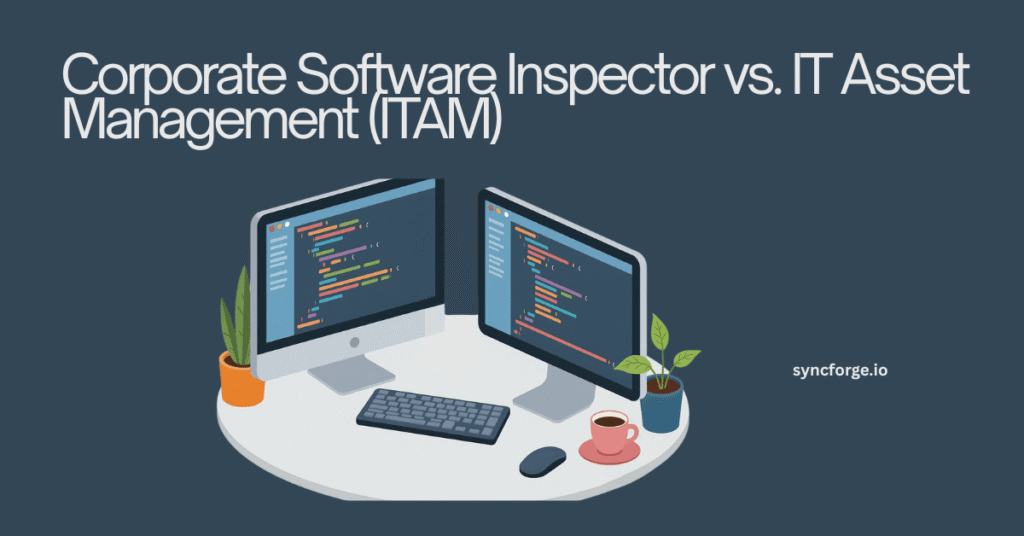
If you are additionally managing hardware lifecycles and budgeting for IT, then a wider ITAM solution will be more appropriate.
How to Choose the Right Tool for Your Organization
Not all solutions work the same way for everyone. Finding the best solution depends on asking a couple of important questions before anything else.
What problem does it solve? If the issue lies within compliance with software licenses and the management of vulnerabilities, then a specialized inspection tool would be enough. If hardware lifecycle management is required as well, an ITAM solution would be a good idea.
Is it designed to support your environment? If there are any hybrid teams, remote endpoints, or cloud environments, then this factor is crucial.
Does it integrate with your existing technology stack? If your tool is incompatible with your ITSM solution, security information and event management (SIEM) system, and procurement tools, you’re creating more headaches for yourself than you are solving.
Is it readable for people outside of IT? Your dashboards might make perfect sense to the person who built them but do they also make sense to the compliance officer or financial director?
Will the vendor keep up with your growth? The tool should be able to handle 200 devices now but should also be scalable enough to handle 2,000.
Common Mistakes Companies Make
With all the correct software in place, there are certain mistakes that prevent businesses from obtaining the desired result. These mistakes can be observed in different companies, whatever their size.
Thinking about it as a single project. A software environment is changing on a weekly basis and not an annual one. There is no benefit in installing a tool if it is not constantly monitored.
Neglecting low-severity alerts. Minor problems that are left open for months may turn out to be the only way through which attackers gain access. Current low-severity doesn’t guarantee the same situation next quarter.
Not engaging other departments besides IT. Most cases of Shadow IT occur because people from marketing, sales, and finance sign up for certain tools without getting permission from the IT department.
Not doing license reconciliations. Most businesses use such tools for security reasons but ignore cost savings. Thus, leaving some money on the table each year.
Frequently Asked Questions
What exactly does a Corporate Software Inspector do?
It audits every piece of hardware within a network to produce a complete software asset list, which is then compared to vulnerabilities, licensing, and internal policy in order to detect any issues.
Is it just beneficial to large businesses?
Not at all. The effect is most significant in large corporations because of their size, but medium-sized businesses gain just as much by detecting unused licenses and security vulnerabilities.
How does that differ from antivirus tools?
Antivirus tools detect harmful software that is already installed on the system. A Corporate Software Inspector detects potentially dangerous software – old, unlicensed installations, or shadow IT – before they become an issue.
Does it replace a full IT Asset Management platform?
Not really. It will work well with software discovery, licensing, and vulnerabilities. However, hardware lifecycle management and procurement require more advanced ITAM platforms.
How frequently should scans be performed?
Continuous or daily scans are considered the norm these days. Shadow IT and new installs can occur at any time, so quarterly scans result in large periods when the organization doesn’t have an adequate picture of its software portfolio.
Is it useful during vendor audits?
Yes, because it keeps a real-time inventory, the tool creates audit reports immediately upon request without rushing each time.
Final Thoughts
It’s only getting worse. The addition of more AI, browser plugins, and single click software sign-ups is only adding to the problem.
Corporate Software Inspector provides an essential tool that’s often missing from most companies’ toolkit – visibility into what’s really running across their enterprise.
Companies who make this part of their long-term infrastructure planning and not a once-a-year compliance task are those who are able to identify issues before they become serious. By 2026, this type of visibility will be standard practice.