

B2B SaaS Marketing in 2026: Trends, Funnel & Best channels
Attracting a business for a SaaS product is more complex and challenging than attracting a consumer, as impulsive and emotional triggers are less effective in B2B. In B2B marketing, decisions are rooted in data, facts, and long-term planning.
Commitment is made after a deliberate process and approval from multiple decision-makers. Unlike B2C marketing, B2B marketing is primarily focused on logic and long-term planning.
In subscription-based products, winning a customer once is never enough; retaining the customer for the long term is the real breakthrough everyone runs after. Customer Lifetime Value (LTV) plays the most crucial role in driving sustainable growth for any SaaS business.
What is B2B SaaS Marketing?
As the name suggests, B2B SaaS marketing deals with selling software-based solutions to businesses. It’s less about winning customers but more about retaining the existing ones.
As SaaS runs on subscriptions, one-time product sales are not very good news for SaaS businesses. Keeping those customers happy and maximizing customer Lifetime Value (LTV) makes you a long-race horse.
In 2026, B2B SaaS marketing has evolved far beyond generating traffic or leads only. It becomes a matter of optimizing pipeline quality, maximizing Lifetime Value (LTV), and fostering long-term relationships.
The goal has shifted towards keeping the customer engaged over an extended period by providing educational content and valuable insights, to make them familiar and comfortable with your product and company, before even talking to a sales representative.
What drives this change? Informed and modern buyer behaviour has driven this change because buyers are no longer looking for software products and their endless features, but they are focused on what specific business problems those products solve.
They seek the pain point of their business that SaaS products can address. Flashy ads don’t help marketers anymore, so B2B SaaS marketers are adopting AI-driven personalization and experience-led growth to yield optimal results.
How Does B2B SaaS Marketing Work in 2026?
In B2B SaaS Marketing, decisions are not made on whim and usually involve a slow process due to its nature and complexity.
Similarly, siloed marketing tactics have become outdated; in today’s era, everything is fastened from SEO to paid acquisition and content writing to product marketing, all aspects teamed up in a full funnel system to provide a flawless experience.
SaaS industry leaders have diverted from aggressive sales tactics to educating their buyers and building trust prior to pushing them for a demo. Top SaaS companies follow these three steps for attracting customers in B2B SaaS marketing.
- Addressing a specific business pain
- Educating buyers step by step
- Building trust before pushing them to demo
The shift to queries-first marketing has driven this change because businesses do not search for software tools generally; they are aware of their business problems and are seeking solutions for those problems.
Today, search engines are bombarded with more specific and well-defined queries such as:
“How to automate B2B sales workflows?”
“What are the best tools for SaaS customer onboarding?”
Certainly, SaaS companies targeting these specific queries through their educational content, providing answers to all their whys and hows, are more likely to transform that lead into a paying customer afterwards.
AI-powered account-based marketing (ABM) and intent data help SaaS companies to offer personalized services to buyers.
Key 2026 Differences:
- Pipeline quality has outperformed lead volume. Now, SaaS companies aim to improve the ratio of customer acquisition cost (CAC) to lifetime value (LTV) from 3:1 to 4:1
- The average of visitor-to-lead conversions in B2B SaaS marketing is 1-3 %, but it sits at 8-15% for the best performers due to intent data.
- Demo-to-customer conversion rates lie between 20-30%, but multi-stakeholder decision-making makes it very difficult to achieve the target.
- SaaS companies that have embraced AI-powered personalization are on top by winning greater market trust and higher conversion rates.
Do you know the secret behind the top performer’s success in the industry? It’s the unified growth framework where they are integrating everything from SEO, paid ads, and content marketing. Not sticking to only one channel is the secret behind their success.
What are the biggest challenges in B2B SaaS Marketing today?
In this saturated SaaS market, where few SaaS companies are thriving, many are struggling as well, and marketing misalignment is one of the biggest causes of mediocre performance.
It leads to ineffective campaigns, high customer acquisition costs (CAC), and high bounce rates.
Let’s unfold a few hindrances in B2B SaaS marketing:
High CAC from Paid Ads:
I have seen many B2B SaaS marketing companies burning thousands in inefficient, flashy ads, which give them little to no return. They overspend in acquiring new customers but in vain.
In this case, CAC: LTV, CAC weighs more, which is a bad indicator for any company.
Low Demo to customer conversion:
The average visitor-to-lead conversion is not very high, even for top performers; it sits between 8 to 15%, and as low as only 1-3% for other companies.
Even these low rates are difficult to achieve as decisions are reviewed by multiple stakeholders. Low visitor-to-customer rates are common across industries.
Long Sales Cycle:
In B2B SaaS marketing, decisions are not as instant and impulsive as in B2C. At the enterprise level, it is a slow and deliberate process.
Sometimes it takes as much as 6 months to finalise enterprise-level deals, posing a huge hindrance in the SaaS business as extended cycles delay and complicate every process.
Poor Onboarding and Churn:
Annual 10-12 % churn is pervasive across SaaS industries, which makes the matter even worse.
Weak Content:
Content that generates more leads is ineffective if the leads bounce back and do not convert into paying customers. The generic content won’t do much, and the buyer will walk away if they can’t find a solution to their problem in your content.
How to overcome these Challenges?
Adding more channels in B2B SaaS marketing can help you generate leads, but not paying customers.
AI-driven intent data, along with better intent targeting and clearer positioning, is a smarter and more effective solution.
Moreover, aligning content to address real buyer questions won’t just generate traffic but tangible results as well.
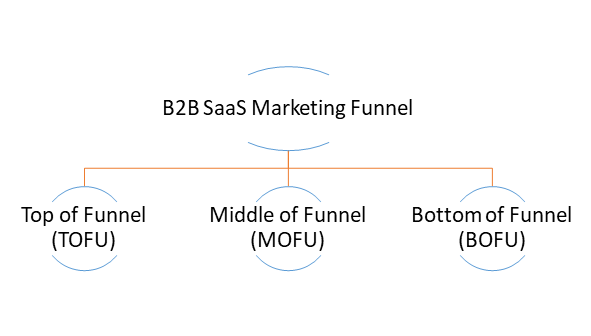
B2B SaaS Marketing Funnel Explained:
The B2B SaaS marketing funnel is unique from traditional marketing funnels. Today, the buyer is aware of the market, product, and business problems.
They don’t search keywords, but problem-aware queries. Let’s break down the b2b SaaS marketing funnel and understand it step by step. Have a look at an easy-to-scan table given below:
| Funnel Stage | Top of Funnel (TOFU) | Middle of Funnel (MOFU) | Bottom of Funnel (BOFU) |
| Buyer’s Awareness | Problem-Aware | Solution-Aware | Product-Aware |
| What are they looking for? | Buyers at this stage realize they have a problem, but are unsure of the solutions. | Buyers are aware of their problem and are now researching solutions. | Buyers are ready to choose a solution, comparing products to make a final decision. |
| Example Questions | “How to automate B2B sales workflows?” | “Best CRM for B2B SaaS companies?” | “HubSpot vs Salesforce for SaaS?” |
| Content Focus | Educating buyers | Comparing different solutions and narrowing down options. | Final decision-making with clear product details. |
| Content Types | Educational content: Blogs, Industry Reports, Comparison Guides | Case Studies, Product Comparisons, Webinars | Demos, Free Trials, ROI Calculators |
| Goal of Content | Help buyers understand problems and identify the best solutions. | Guide the buyer through the comparison of various solutions and show why your product is a good fit. | Encourage buyers to take action with demos, trials, and clear pricing information. |
The journey starts with problem-aware queries, then steps into solution-aware queries, and finally ends at product-aware queries. This journey enables the buyer to decide which product addresses their business pain point most effectively.
Which Channels work best for B2B SaaS Marketing?
B2B SaaS marketing is not stagnant; it continues to evolve. Similarly, all channels are not created equal and do not produce the same results.
One shoe never fits all, so choosing the right channel is a strategic approach. There is no choice in this matter. Let’s discuss the most effective channels of 2026 that foster long-term customer relationships:
SEO and Content Marketing:
SEO and Content marketing remain the mainstay of B2B SaaS marketing. SEO content focusing on product features is considered less effective as it only generates leads.
However, content addressing pain points of businesses, offering problem-based content, and product-led pages can attract high-intent traffic. Only SEO yields 702% ROI. Moreover, it offers a 7-month payback period with a 15% lead-to-sale conversion.
Linkedin and B2B Social:
LinkedIn is becoming a crucial and most effective channel in B2B SaaS marketing. This platform has no match in founder-led content and case study promotion.
Moreover, it is a powerful tool for retargeting warm audiences. SaaS companies are seeing 113 % return on advertising spend (ROAS) on LinkedIn as well, making it a must in B2B SaaS marketing in 2026.
Paid Search (Google Ads):
Paid ads work best in the last stage of the funnel (BOFU), where buyers become product aware, and you can attract them through demo-ready search terms and competitor keywords.
It would not only attract traffic but also convert them into paying customers.
Email and Lifecycle Marketing:
Email marketing remains indispensable in driving upsells. SaaS companies have reported a surge of 120-140% in Net Revenue Retention through email marketing.
How do B2B SaaS Companies Generate Qualified Leads?
Having 1000 leads but only 10 conversion leads to disappointment and frustration in SaaS marketers. Lead generation is not about volume anymore; it’s about quality.
Marketers seek sales-qualified leads (SQL)s. Do you know the best strategies to generate qualified leads? Here’s the answer:
- SEO content with strong intent that targets the pain points of buyers and businesses.
- Product‑led free trials that allow users to recognize the value of your product.
- Webinars with niche topics attract 20-30% attendance-to-lead
- Partner marketing adds 15-25% leads by aligning magnets to queries for 2-3x quality lift.
The bottom line is that they don’t offer general ebooks but specific content targeting a pain point like “Best CRM for SaaS Companies.”
What is Product-led growth in B2B SaaS marketing?
Product-led growth is a modern marketing approach where the product itself acts as a primary marketing channel to drive customer acquisition, conversion, retention, and expansion.
In 2026, it became a common trend to blend PLG with sales-led strategies, as it lowers marketing expenditure. Moreover, it creates a hybrid approach that offers sustainable growth. PLG yields optimal results when:
- Onboarding is frictionless, so users have a smooth experience.
- Users can quickly experience the product value.
- Usage data is used to fuel marketing efforts.
SaaS companies embracing PLG reported that their sales cycle has been reduced by 40%, and customer acquisition costs have also been reduced.
How to reduce churn with B2B SaaS Marketing?
Acquiring a new customer is important, but maintaining a long-term relationship with them is even more important. Retention has become the new acquisition. Let’s find out how SaaS companies are cutting churn rates:
- Post-signup education guides users on how the best can be achieved with the product.
- Feature Adoption content motivates users to explore more of the product, it facilitates customer familiarity with your product, and helps you win their trust.
- Segmentation based on behavior provides a more personalized experience to users, which leads to customer retention
These strategies help businesses to recover 10-20% of their lapsed users. Automated workflows and feedback loops in marketing lead to low churn rates.
What are the B2B SaaS marketing Trends in 2026?
Let’s have a quick look at trends shaping the future of B2B SaaS marketing in 2026:
- AI-powered personalization to provide customized experiences.
- intent-based targeting to increase customer engagement.
- founder-led brand development that fosters trust and humanizes businesses.
- community-driven expansion that makes use of user groups for natural advertising.
- pricing strategies based on usage that match product costs to usage.
- Early adoption of these trends by SaaS companies will boost their expansion and foster stronger, more reliable customer relationships.
SaaS businesses that will keep up with these trends will stay at the top in 2026 and will easily win the battle of survival in the continuously blooming SaaS market.
Final Thoughts:
In 2026, B2B SaaS marketing is all about clarity, intent, and alignment. The one who will answer the right questions at the right time, embrace AI-driven personalization, and focus on long-term customer retention will lead the market. Stop marketing the features of the product, start focusing on the solution your product provides.
FAQs
IS B2B SaaS Marketing very expensive?
It can be a little expensive for small startups, but SEO and PLG can contribute to cutting long-term costs.
How long does B2B SaaS marketing take to work?
SEO and content are a slow process, and results start appearing between 3 and 6 months. However, paid channels generate instant results.
What is the best marketing strategy for early-stage SaaS?
SEO, niche positioning, and clear ICP work best before scaling paid ads.
Do B2B SaaS companies need content marketing?
Definitely. Content speaks on your behalf; it educates buyers, builds trust, and acts as a building block in the entire marketing funnel.
What metrics matter most in B2B SaaS marketing?
CAC Payback Period, LTV: CAC Ratio, Trial-to-Paid Conversion, Net Revenue Retention (NRR), all these metrics ensure sustainable growth.
How can I reduce churn in my SaaS business?
You can reduce churn rates by focusing on onboarding, creating educational content, and keeping your users engaged and satisfied.
CTA:
Implement these tactics in your B2B SaaS Marketing strategy! and let the magic happen to your growth curve. Stay tuned for more SaaS updates.